White Paper: Bottle Traceability in Returnable Packaging

Background
Returnable beverage packaging systems are one of the most established models of circular packaging in practice. Across many European markets, returnable glass bottles already operate within mature collection, washing, refilling, and redistribution networks built over decades. These systems are familiar, operationally proven, and closely linked to broader ambitions around waste reduction, packaging reuse, and more efficient use of materials.
Yet the day-to-day management of these systems still depends heavily on partial visibility. In most cases, bottles move through the network as pooled assets, and operational insight is built from crate-level, pallet-level, or batch-level data rather than from direct observation of the individual bottle. As a result, many of the most important questions in a returnable system remain difficult to answer with precision: how long bottles remain in circulation, where losses occur, how reuse patterns differ across markets or channels, and how effectively the system performs over time.
This visibility gap matters beyond operations alone. In a European market where circular systems are increasingly expected to demonstrate measurable performance rather than simply to exist, the inability to observe individual bottle behaviour creates real constraints. For fleet management, reverse logistics, and packaging availability decisions, partial data means partial control.
Bottle-level traceability addresses this directly. Not because returnable systems are broken, but because the limits of traditional tracking are no longer easy to ignore. The challenge is to create a clearer view of how individual packaging assets actually move through a live industrial system without disrupting the speed and efficiency on which that system depends.
Visibility Gap
Returnable bottle networks are designed for control. Across filling, distribution, return, washing, and refill, they rely on established processes to keep packaging assets moving through the system efficiently and at scale. At aggregate level, operators can monitor volumes, flows, and activity across key points in the network.
What remains difficult to observe directly is how individual bottles perform within that system over time.
This does not mean returnable systems lack data. It means that the data available is usually structured around grouped movement and aggregate returns rather than individual asset behaviour over time. As a result, operators may have substantial system-level visibility while still lacking precise insight into how many times a bottle has circulated, where it has experienced the greatest stress, or which parts of the network are associated with shorter asset life and higher damage rates.
The limitation is not a lack of control, but a lack of precise visibility into the bottle.
Why Bottle-Level Traceability Has Been Difficult
Glass is one of the hardest packaging materials to read reliably at industrial speed. It is transparent, reflective, and refractive. Light behaves differently on glass than on paper, plastic, or printed surfaces, and the conditions inside a working bottling line, including varying angles, moisture, heat, and surface wear, make consistent optical identification genuinely demanding.
That difficulty compounds in returnable systems specifically. In a one-way packaging line, a unit is scanned once under reasonably controlled conditions. In a returnable system, the same bottle needs to be identified reliably across dozens of cycles, each time in a potentially different state. Scratches accumulate. Surfaces degrade. Washing and handling change how light interacts with the glass. An identification system that works on a new bottle has to keep working on the same bottle after repeated refill cycles.
The operational environment adds another layer of difficulty. Returnable bottle systems run at speed, and any identification layer has to work within the existing process without interrupting it. There is no room to slow the line, reposition bottles, or create controlled reading conditions. Identification has to happen as the bottle moves, in the state it arrives, as part of normal production.
Together, these constraints explain why bottle-level traceability in returnable glass systems remained operationally out of reach for so long. The barrier was not the concept. It was making reliable identification work on glass, at line speed, repeatedly, across the full life of a working bottle.
How it becomes possible
What made bottle-level traceability operationally viable was not a single breakthrough but the convergence of two developments moving in parallel.
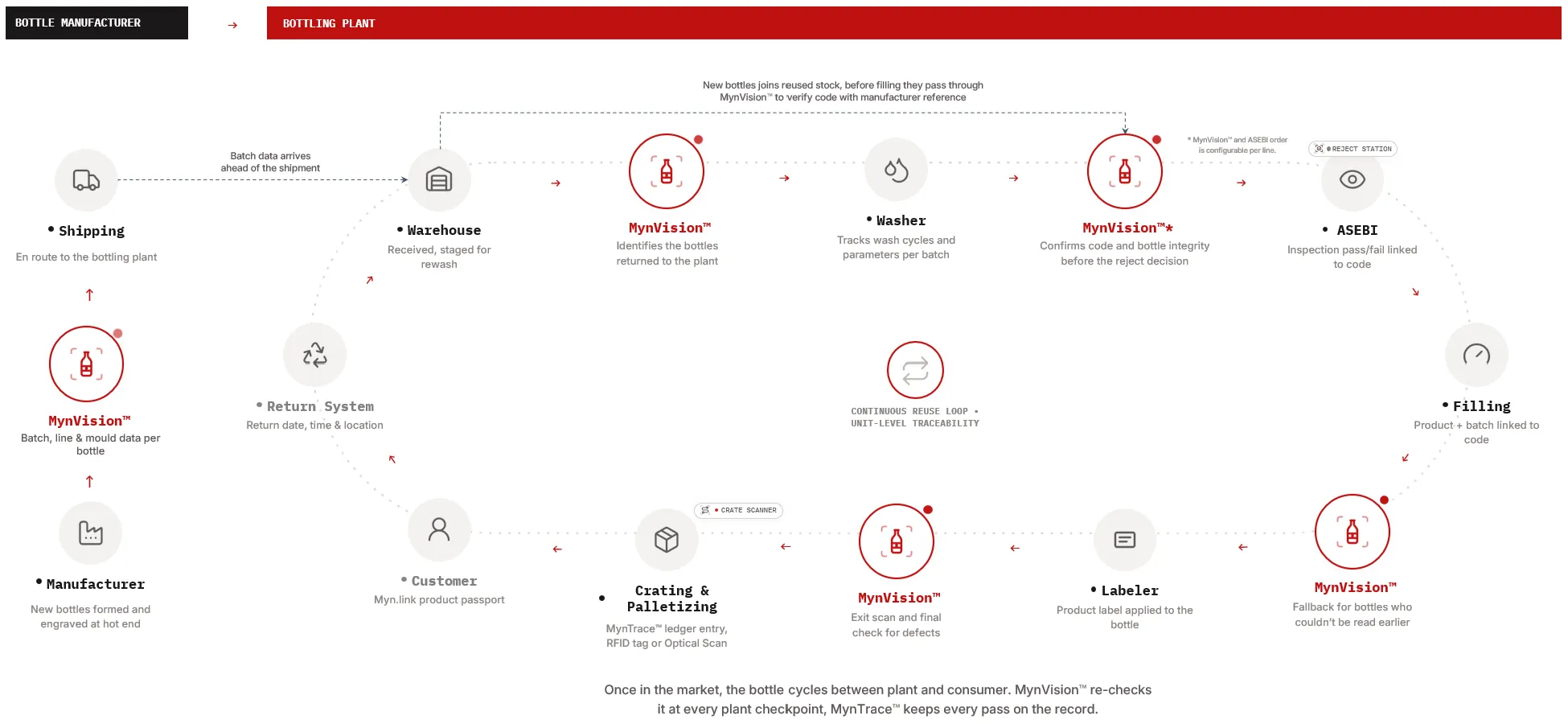
The first is the availability of bottles carrying permanent, embedded identifiers. A data matrix marked directly into the glass at the manufacturing stage behaves differently from any printed code. It survives washing, handling, and repeated use cycles with significantly greater durability than any printed or applied alternative. This is a specific manufacturing capability that requires investment and intention upstream in the supply chain. It is not yet universal, but glass producers such as Vetropack have begun moving in this direction, creating the stable identifier foundation that a traceability system requires.
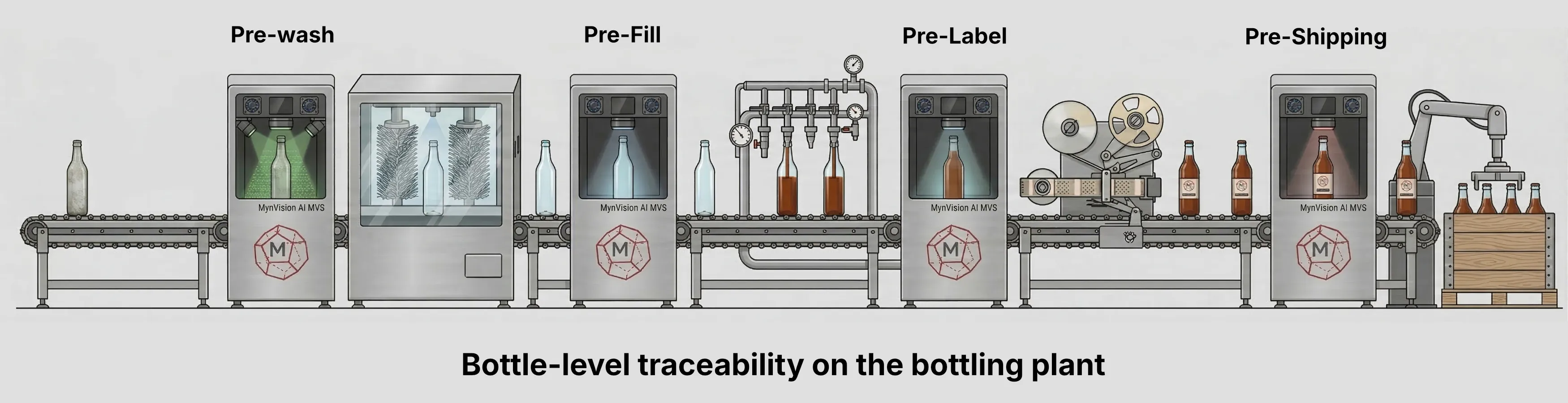
The second is the maturity of AI-powered machine vision capable of reading those identifiers under live production conditions. A data matrix embedded in glass is a genuinely difficult object to read consistently. It is transparent, reflective, subject to wear, and moving at the speeds commercial bottling lines demand. Advances in high-speed imaging, specialised optics, and machine learning models trained on the specific challenges of glass surface shave made reliable reading achievable in a way it was not before. Myneral Labs has built this capability for commercial returnable bottle environments.
When these two elements are present together, a third becomes possible: data continuity. Each time a bottle passes through an instrumented point on the line, its identifier is captured and linked to a new operational event. Overtime, those events accumulate into a structured history of how that specific bottle has moved, been used, and performed across repeated cycles.
Operational Benefits and Strategic Value
Direct observation of bottle behaviour changes how returnable systems can be managed. Where operators previously relied on aggregate return figures andfleet-wide averages, they can now observe how individual bottles circulate, where losses concentrate, and which parts of the network are associated with shorter asset life. That shift from inference to direct observation has immediate consequences for fleet planning, reverse logistics, packaging availability, and pool management.
The same data carries value beyond operations. As individual bottle histories accumulate, performance can be compared across markets, regions, channels, and retail environments with a level of precision that aggregate data cannot support. Returnable packaging stops being a largely anonymous asset pool and becomes a source of structured commercial intelligence. For trade and commercial functions, that means more credible conversations with retail and channel partners, better-informed decisions about packaging mix, and a stronger analytical foundation for customer-specific returnable strategies.
There is a broader dimension to this as well. Returnable systems are increasingly expected to demonstrate their performance, not simply to operate. Sustainability reporting, emerging regulatory frameworks around packaging, and growing scrutiny from retail and brand partners are all moving in the same direction: towards verifiable, unit-level evidence of how circular systems actually perform. This data does not just support internal decision-making. It generates the kind of structured, auditable record that external reporting and commercial transparency increasingly require.
Packaging regulation in Europe, most visibly through the PPWR, is moving towards documented, verifiable performance at the packaging level. A bottle with a structured operational history is not just an operational asset. It is increasingly a commercial and regulatory one.
The CCEP Deployment
The deployment at Coca-Cola Europacific Partners did not set out to prove a theory. It set out to make bottle-level traceability work inside a real commercial bottling operation, at their production facility in Bad Neuenahr, Germany.
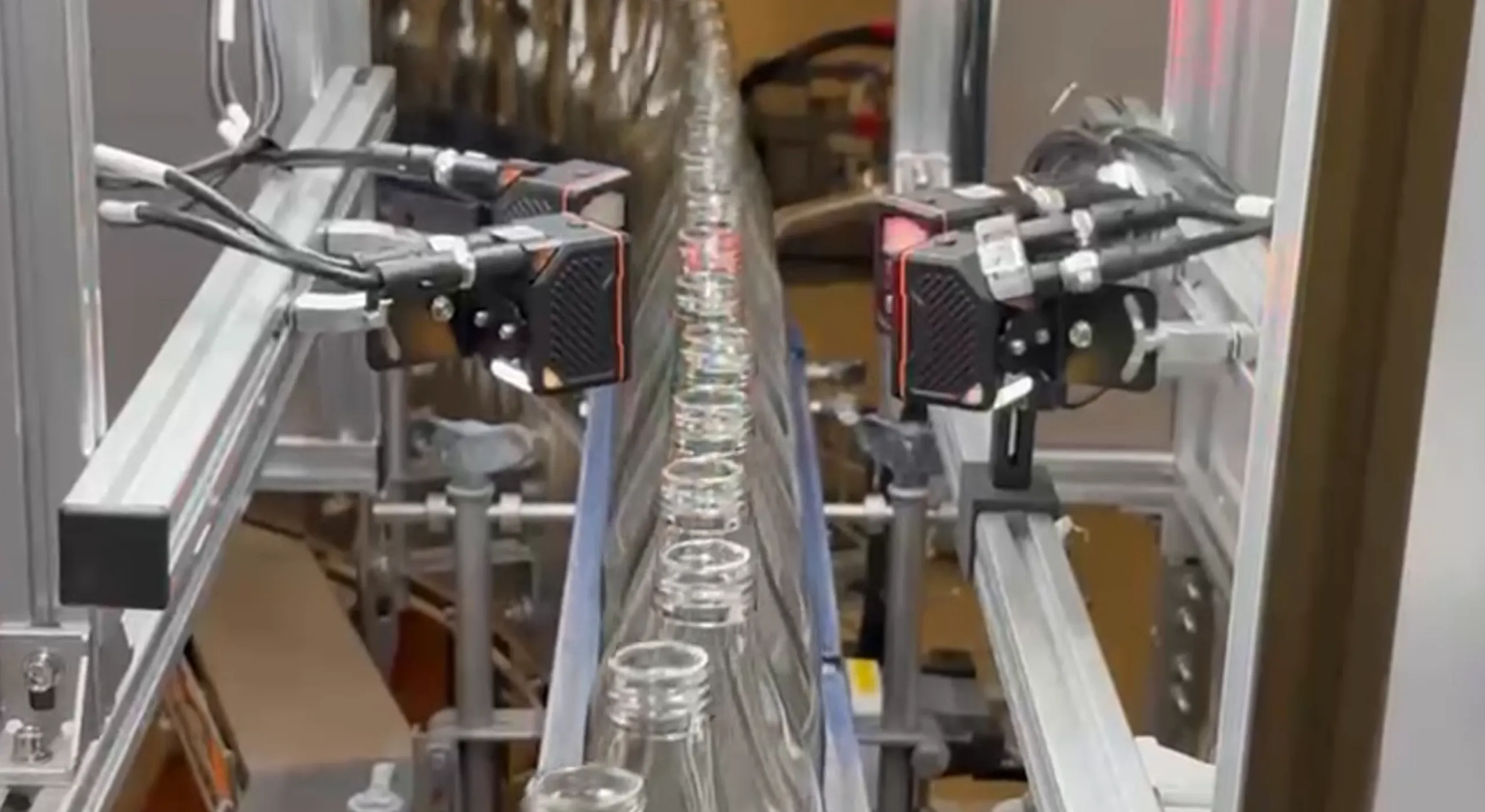
The project brought together three partners with distinct but complementary roles. Vetropack engraved a data matrix code into each bottle during the manufacturing process. Myneral Labs deployed AI-powered camera systems on the production line to read those codes reliably at operational speed. The captured data feeds into the Myneral Trace platform, where each bottle's digital record is maintained. CCEP provided the operational environment and the industrial context in which the full system had to perform.
The bottles in scope were returnable glass containers for two of CCEP's water brands, working commercial bottles in active circulation rather thanpurpose-built test units. That distinction matters. The deployment was not conducted in a controlled laboratory environment. It was integrated into a live bottling operation where the system had to perform under real production conditions.
What the deployment addressed directly was a limitation CCEP acknowledged explicitly: that circulation figures and loss assumptions for returnable glass bottles had previously been based on experience values and models rather than direct observation. For the first time, those figures could be verified at individual bottle level. Each bottle now carries a continuous digital record, atime-stamped history of its passage through production anchored in ablockchain-backed architecture.
The next step is a second site. With two instrumented locations, itbecomes possible to track an entire bottle pool end to end, following individual bottles not just through a single production line but across the full circulation loop between facilities. That is the point at whichbottle-level traceability moves from a production capability to a genuine network intelligence tool.
Conclusion
Returnable bottle systems are a proven model of circular packaging. What has been missing is not the system itself, but the data layer beneath it: direct visibility into how individual bottles actually behave across repeated cycles of use, return, and refill.
Permanently marked glass, AI-powered machine vision, and a data architecture capable of maintaining continuous bottle-level records have each matured. Together, they make it possible to move from aggregate assumptions to direct observation. Returnable packaging can now be understood, managed, and improved at the level of the asset it is built around.
The significance of that shift extends beyond operational efficiency. It reaches into how returnable systems demonstrate their performance, how they respond to growing commercial and regulatory expectations, and how the data they generate creates value across the supply chain over time.
What the deployment at Coca-Cola Europacific Partners demonstrates is that this is not a future capability. With Vetropack marking each bottle at the manufacturing stage, Myneral Labs reading and recording it at operational speed, and Coca-Cola Europacific Partners integrating it into a live commercial operation, bottle-level traceability in returnable glass is already an operational reality.